When selecting concrete pumping equipment for construction sites, ensuring that the size of mixer-equipped or trailer-mounted models fits the site conditions is a prerequisite for ensuring construction efficiency and safety. Concrete pumping equipment such as concrete mixer with pump for sale, tow behind concrete pumps, and small concrete pump for sale come in various sizes, and mismatched dimensions may lead to problems such as difficulty in equipment placement, inability to reach the construction area, or even damage to on-site facilities. For construction units, whether choosing small, flexible models or larger trailer-mounted equipment, it is necessary to conduct a comprehensive analysis of the site and equipment dimensions. This article will systematically elaborate on the key steps and considerations to ensure the size of such concrete pumping equipment fits the site, providing practical guidance for purchasers and construction planners.
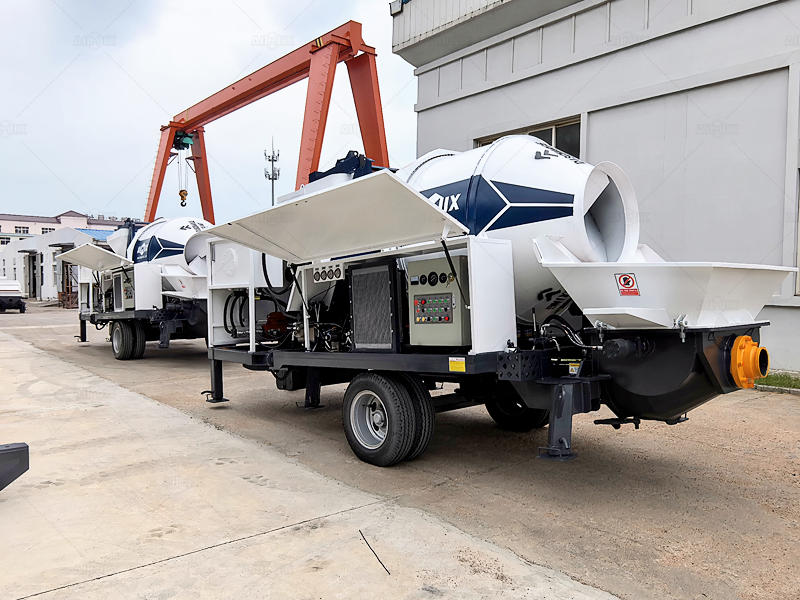
Conduct a Detailed On-Site Survey to Clarify Spatial Constraints
The first and most critical step to ensure the size of concrete pumping equipment fits the site is to conduct a detailed on-site survey, which helps to accurately grasp the spatial constraints and avoid blind selection. The survey should cover multiple dimensions of the construction site. Firstly, it is necessary to measure the available space for equipment placement, including the length, width, and height of the parking area, as well as the distance from the placement point to the pouring area. For example, in narrow urban construction sites or indoor renovation projects, the available space is often limited, so compact models such as small concrete pump for sale or small-sized concrete mixer with pump for sale should be prioritized. Secondly, it is necessary to check the access routes of the site, such as the width of the entrance gate, the turning radius of the road inside the site, and the load-bearing capacity of the road surface. Tow behind concrete pumps, as a common trailer-mounted type, require sufficient road width and turning space for towing and maneuvering; if the site entrance is narrow or the road has sharp turns, it is necessary to confirm that the equipment’s overall length and turning radius can pass smoothly. In addition, it is necessary to take into account the height constraints of the site, such as the height of overhead power lines, bridges, or indoor ceilings, to avoid collisions caused by the excessive height of concrete pumping equipment during operation. Finally, the survey should also record the location of on-site obstacles (such as piles, pipelines, and existing buildings) to ensure that there is enough safety distance between the equipment and obstacles after placement.
Clarify Equipment Size Parameters and Match Site Requirements
After completing the on-site survey, it is necessary to clarify the key size parameters of the selected concrete pumping equipment and match them with the site constraints. Different types of concrete pumping equipment have distinct size characteristics. For concrete mixer with pump for sale, which integrates mixing and pumping functions, the key size parameters include the overall length, width, height of the equipment, the length of the pumping boom (if equipped), and the turning radius during movement. For example, a small concrete mixer with pump usually has an overall length of 5-7 meters, a width of 2-2.5 meters, and a height of 2.5-3 meters, which is suitable for small and medium-sized sites with limited space. Tow behind concrete pumps, as typical trailer-mounted concrete pumping equipment, have size parameters that focus on the trailer’s length, the folding size of the pumping mechanism, and the required towing space; their overall length after folding is usually 6-10 meters, and the width is about 2.3-2.8 meters, requiring the site to have sufficient towing and parking space. For small concrete pump for sale, which is widely used in small-scale projects, its compact size (length 4-6 meters, width 1.8-2.2 meters) makes it suitable for narrow sites, but it is still necessary to confirm that its pumping range can cover the entire pouring area. When matching, it is necessary to ensure that the equipment’s overall dimensions are smaller than the available placement space, the turning radius is compatible with the on-site road conditions, and the boom length (if any) can reach the target pouring point without being blocked by obstacles.
Combine Construction Needs to Determine Equipment Functional Size Requirements
Ensuring the size of concrete pumping equipment fits the site is not only about spatial adaptation but also about matching the functional size with construction needs. Different construction tasks have different requirements for the functional dimensions of the equipment. For example, in high-rise building construction, if using trailer-mounted concrete pumping equipment with a boom, the boom length (a key functional size parameter) must be sufficient to reach the corresponding floor height; while in low-rise residential construction, a shorter boom length is sufficient, and excessive length may cause inconvenience in operation and waste of space. For concrete mixer with pump for sale, the size of the mixing drum (which determines the mixing capacity) and the length of the pumping pipeline should also be matched with the site’s concrete demand and pouring distance. If the site’s daily concrete demand is small, a small concrete pump for sale with a small mixing drum and short pipeline is more appropriate, which not only saves space but also reduces energy consumption. Tow behind concrete pumps, which are often used for long-distance conveying in large-scale sites, require the length of the towing frame and the configuration of the pumping pipeline to be adapted to the site’s conveying distance and layout. In addition, it is necessary to consider the size of the equipment’s feeding port and the space required for material loading, ensuring that the feeding vehicle can approach smoothly and complete the feeding operation without interfering with other on-site equipment.
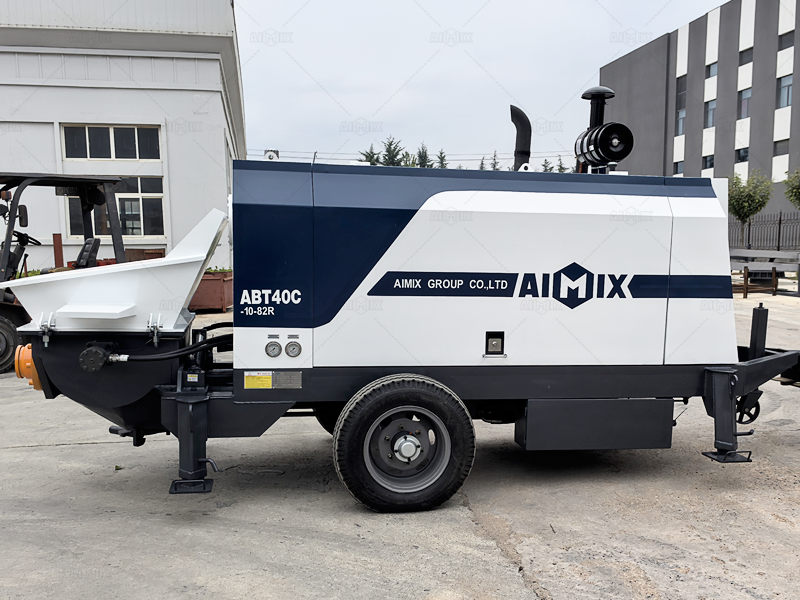
Evaluate the Compatibility of Equipment with On-Site Auxiliary Facilities
The size of concrete pumping equipment also needs to be compatible with on-site auxiliary facilities to ensure the smooth progress of the entire construction process. Firstly, it is necessary to confirm that the equipment’s size matches the on-site loading and unloading conditions. For example, if the site uses a crane to assist in equipment placement, the equipment’s overall weight and size must be within the crane’s lifting capacity and working range. Secondly, it is necessary to consider the compatibility with on-site power supply and water supply facilities. For small concrete pump for sale or concrete mixer with pump for sale that require on-site power connection, the size of the electrical control box and the length of the power cable should be adapted to the location of the on-site power source, avoiding the need for long-distance cable laying which may affect the operation. For tow behind concrete pumps, which are usually towed by tractors, it is necessary to confirm that the tractor’s size and towing capacity are compatible with the pump’s size and weight. In addition, the size of the equipment should also take into account the on-site maintenance space. It is necessary to reserve sufficient space around the equipment for daily inspection, maintenance, and parts replacement, which is particularly important for ensuring the long-term stable operation of the equipment. For example, large trailer-mounted concrete pumping equipment requires a wider maintenance space than small models, and the site should make corresponding reservations.
Test and Verify with Equipment Samples or Simulation Methods
To further ensure that the size of the selected concrete pumping equipment fits the site, it is recommended to conduct test verification through equipment samples or simulation methods before formal purchase. For suppliers who provide concrete mixer with pump for sale, tow behind concrete pumps, or small concrete pump for sale, purchasers can request to conduct on-site tests with sample equipment of the same model. During the test, the equipment can be towed or moved to the planned placement area to check whether it can be placed smoothly, whether the turning and movement are flexible, and whether the boom (if any) can operate normally without being blocked. For large-scale construction sites or complex site conditions, simulation software can be used to model the site and equipment dimensions, simulating the equipment’s placement, movement, and operation processes to predict potential size mismatches. For example, through 3D simulation, it is possible to clearly see whether the equipment’s boom will collide with on-site buildings during operation, or whether the towing route of the tow behind concrete pump is feasible. Test and simulation verification can help to find and solve size mismatch problems in advance, avoiding losses caused by equipment return or modification after purchase.
Consider Future Site Expansion and Equipment Reusability
When ensuring the size of concrete pumping equipment fits the current site, it is also necessary to appropriately consider future site expansion and equipment reusability to improve the economic benefits of the equipment. If the construction site is expected to expand in the later stage, the selected equipment size should not only meet the current site conditions but also have a certain degree of adaptability to the expanded site. For example, choosing a tow behind concrete pump with a longer boom or a concrete mixer with pump for sale with a modular design can facilitate adjustment and expansion according to the expanded site. In addition, considering that the equipment may be reused in other projects, it is necessary to select a size that is compatible with common construction site conditions. Small concrete pump for sale, for example, has strong versatility due to its compact size and can be applied to various small and medium-sized sites, which is conducive to improving the equipment’s reuse rate. However, it should be noted that the consideration of future expansion should not lead to excessive equipment size that cannot be used in the current site, and a balance between current adaptability and future versatility should be achieved.
In summary, ensuring the size of concrete pumping equipment with mixer or trailer mounted fits the site requires a systematic process including on-site survey, equipment parameter matching, auxiliary facility compatibility, test verification, and consideration of future needs. By comprehensively considering these factors, construction units can select suitable concrete mixer with pump for sale, tow behind concrete pumps, or small concrete pump for sale, avoiding size mismatches and ensuring the smooth progress of construction. For purchasers, fully communicating with equipment suppliers and combining the actual site conditions to make a rational choice is the key to maximizing the value of concrete pumping equipment.